
Navigating the World of A1 English Vocabulary
Live English Time
September 1, 2024
No Comments

CEFR A1

Embarking on the journey of learning a new language can feel overwhelming, but every grand adventure starts with a single, foundational step. In the world of English, that initial stride is known as the A1 level, as defined by the Common European Framework of Reference for Languages (CEFR). And at the heart of A1 lies its core vocabulary – a set of essential words and phrases that will become your first, crucial building blocks for communication.

Think of A1 vocabulary not as a vast dictionary, but as a carefully curated toolbox designed for immediate, practical use. It’s all about equipping you to handle the most basic, everyday situations and introduce yourself to the world in simple terms.

What Does A1 Vocabulary Look Like?

At the A1 level, the focus is on concrete, high-frequency words that are indispensable for initial interactions. Here’s a snapshot of what you’ll typically encounter:

  • Personal Information: Words to introduce yourself and others (e.g., I, you, he, she, name, age, country, nationality).
  • Greetings and Farewells: The absolute essentials (e.g., hello, goodbye, good morning, please, thank you, sorry).
  • Numbers and Quantities: Counting from 0 to 100, basic amounts (e.g., one, two, hundred, a lot, a little).
  • Everyday Objects: Common items around the home, school, or office (e.g., table, chair, book, phone, water, food).
  • Basic Actions/Verbs: Simple verbs to describe routine activities (e.g., to be, to have, to like, to want, to go, to eat, to drink).
  • Family Members: Basic kinship terms (e.g., mother, father, brother, sister, child).
  • Colors, Days, Months: Fundamental descriptors and time indicators.
  • Simple Adjectives: Common words to describe things (e.g., big, small, good, bad, hot, cold).
  • Directions and Locations: Very basic phrases (e.g., here, there, left, right).

The goal isn’t complexity, but functionality. You’re learning the vocabulary to form very simple sentences like “My name is John,” “I am from Spain,” “I like coffee,” or “This is my brother.”
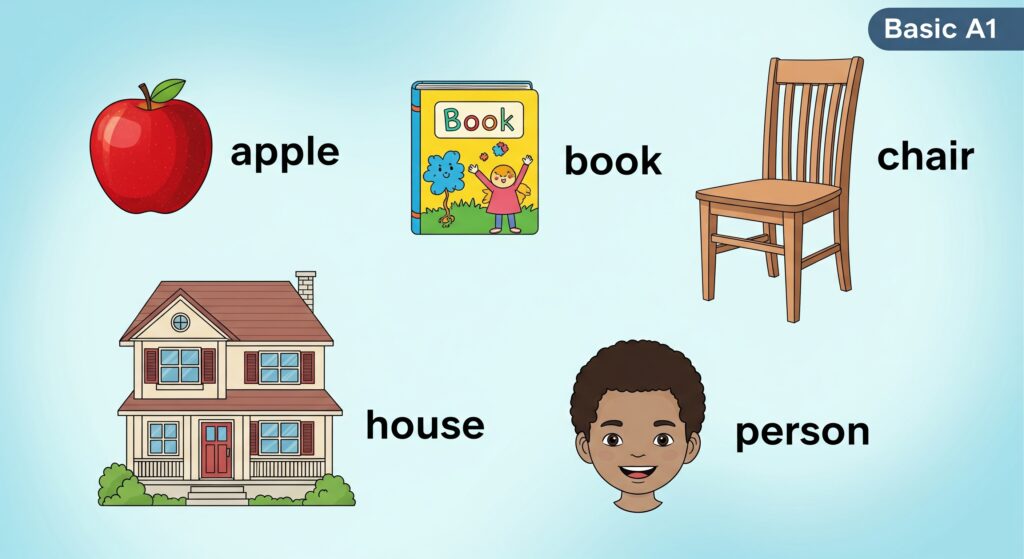
Tips for Mastering A1 Vocabulary:

  • Context is King: Don’t just memorize isolated words. Learn them within simple phrases or sentences (e.g., instead of just “apple,” learn “This is an apple”).
  • Visual Aids: Use flashcards with pictures, label objects around your home, or watch simple videos.
  • Listen and Repeat: Pay attention to how native speakers pronounce A1 words and try to mimic them.
  • Use It! The moment you learn a new word, try to incorporate it into your next practice session, even if it’s just talking to yourself. Active recall solidifies memory.
  • Focus on High Frequency: Prioritize words you know you’ll use often.

A1 vocabulary might seem small, but its impact is immense. It’s your first step into the English-speaking world, providing the tools you need to make connections, understand basic information, and confidently say, “Hello, nice to meet you!” Embrace these first words, and you’ll soon find yourself on the path to greater fluency.